EnergyLab and New Energy Nexus launched AusTestBed: non-matching grants funding independent testing for Australian startups, modelled on CalTestBed.
Sydney, Australia, 9 March 2026 — A programme that has helped California clean energy startups collectively raise over half a billion dollars in follow-on investment has come to Australia. EnergyLab and New Energy Nexus announced the launch of the AusTestBed pilot: a first-of-its-kind, non-matching grant that gave Australian clean energy entrepreneurs free access to university testing facilities to validate their technologies and move closer to commercial deployment.
The launch brought California Energy Commission (CEC) Chair David Hochschild to Climate Action Week Sydney. He oversees the highly successful California model, CalTestBed, which AusTestBed is based on.
The pilot programme, made possible by seed funding from Boundless Earth, saw three Australian startups each receive AUD$50,000 to test their clean energy technologies at Australian tertiary, government and private research institutions — at no cost to them, and with no requirement to find matched private investment, and no IP claims. Initial testbed partners included TRaCE (a partnership between UNSW and the University of Newcastle), which provided access to testbed facilities, alongside the University of Melbourne. The three battery and energy storage startups were: Powerblocks, Adoxima, and Carbophite.
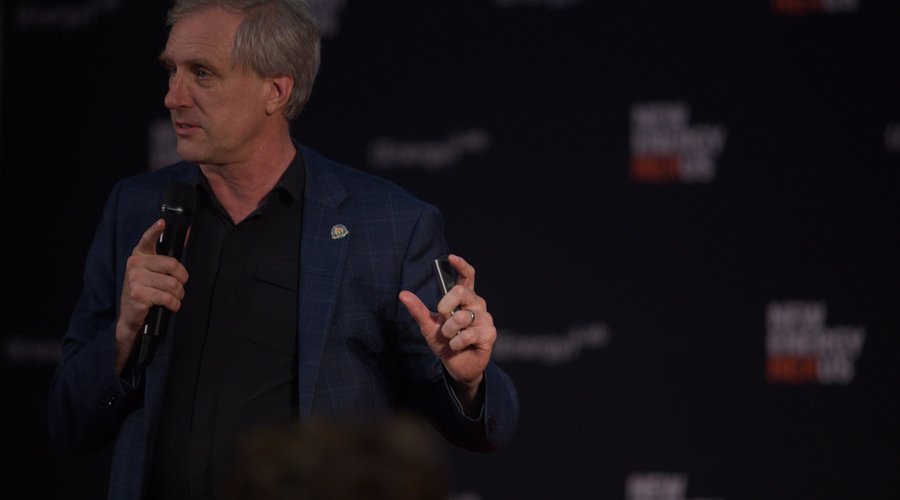
David Hochschild giving the keynote address during the AusTestBed Launch
The announcement was made at Climate Action Week Sydney, where California Energy Commission Chair David Hochschild was in Australia as a keynote speaker. Hochschild, who Governor Gavin Newsom appointed as Chair of the CEC in 2019 and reconfirmed to a third term in 2024, oversees the EPIC programme — the California ratepayer-funded research and development initiative that gave birth to CalTestBed and CalSEED.
Under his leadership, California has become the largest economy in the world to be powered by two-thirds clean energy, adding a record 7,000 megawatts of clean energy capacity to the grid in 2024 alone. California's grid now runs on 100% clean electricity for an average of five hours a day, and the state's battery storage fleet has grown 1,944% since 2019. California is also the world's leading hub for clean energy innovation and investment, home to more clean energy jobs than any other US state and widely regarded as the global benchmark for clean energy policy and deployment.
"California didn't become a global clean energy leader by accident. It happened because we deliberately invested in the innovation pipeline, not just policies and targets. We built public infrastructure and developed programs that got money to entrepreneurs at key moments when private capital wasn’t yet activated. It's exciting to see the launch of AusTestBed, which will offer Australia that same clean energy innovation leverage," said David Hochschild, Chair, California Energy Commission.
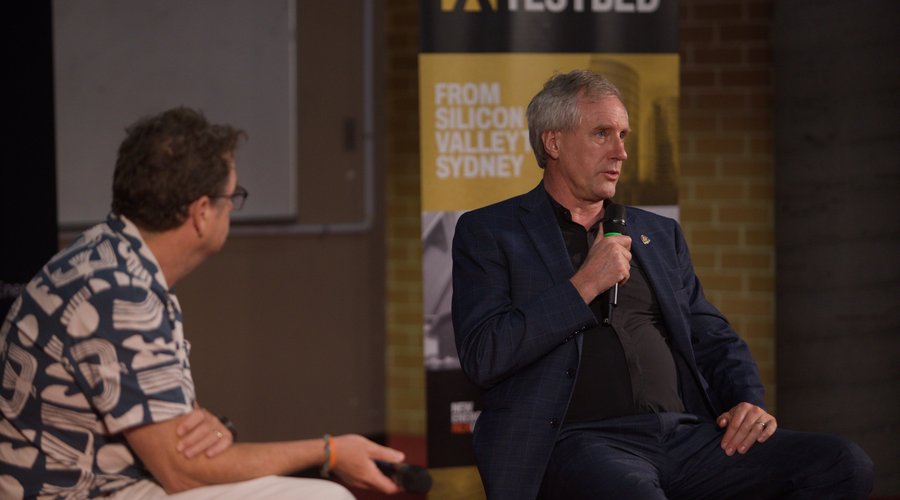
Fireside chat with Danny Kennedy and David Hochschild
AusTestBed is modelled directly on CalTestBed, a voucher programme administered by New Energy Nexus California on behalf of the CEC since 2019. CalTestBed has to date supported 64 clean energy companies and distributed more than US$16.5 million (AUD$23.28 million) in testing vouchers across more than 70 University of California and national laboratory facilities.
The companies that have gone through the programme have collectively raised an estimated US$438 million (AU$617.9 million) in follow-on private investment since participating — a figure that reflects the commercial momentum that third-party testing validation unlocks for startups seeking to attract serious capital. The programme has helped companies advance an average of 1.6 Technology Readiness Levels (TRL) through participation — a meaningful jump on the internationally recognised scale that runs from basic concept (TRL 1) to fully commercial deployment (TRL 9), and one that can determine whether a technology attracts investment or stalls entirely.
The opportunity in Australia is huge. The country has committed over AU$70 billion to decarbonising Australia’s economy over the coming decades and it has world-class university research infrastructure. However, Australia’s early-stage funding programmes usually require matched private investment, creating a structural bottleneck – one that the CalTestBed programme was specifically designed to remove in California. The Investor Group on Climate Change has explicitly identified this bottleneck: 61% of institutional investors cite a lack of investment-ready opportunities as a reason for staying on the sidelines.
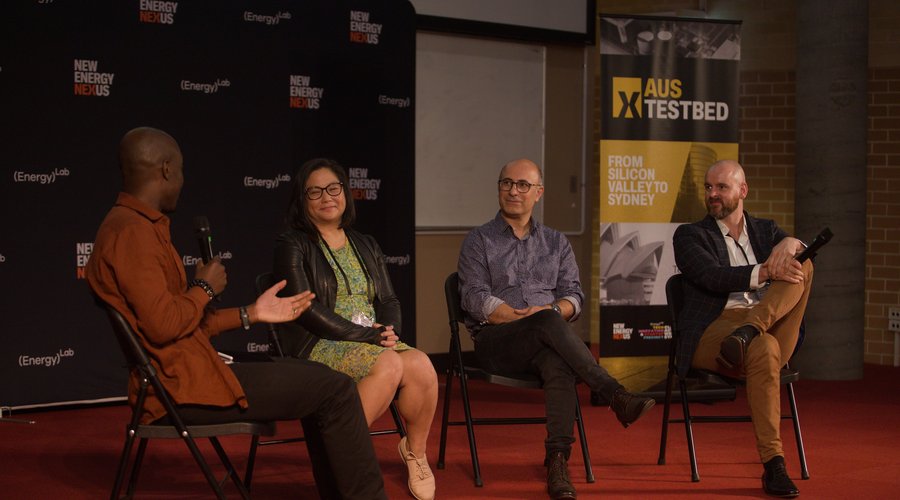
From L - R: Derick Gyabeng and AusTestBed recipients: Julie Leung, Mehrdad Parsa, and Kris Collopy
"We've watched California prove, over five years, that removing the match requirement and giving startups access to world-class testing infrastructure is one of the most effective things a government or philanthropic funder can do to accelerate commercialisation of clean energy startups. Australia has the research assets. It has the startups. AusTestBed is what connects them,” said Andrew Chang, CEO, New Energy Nexus.
"One of the biggest hurdles for Australian startups is the ‘validation gap’ — the distance between a prototype and the independent data required to secure investment. AusTestBed bridges this by providing the third-party proof and de-risking that founders need to move toward commercial deployment at scale,” said Megan Fisher, CEO, EnergyLab.
EnergyLab and New Energy Nexus are calling on the Australian federal government to fund a full national rollout of AusTestBed. Expanding access to non-matching early-stage funding is a key lever to accelerate systemic progress in Australia.
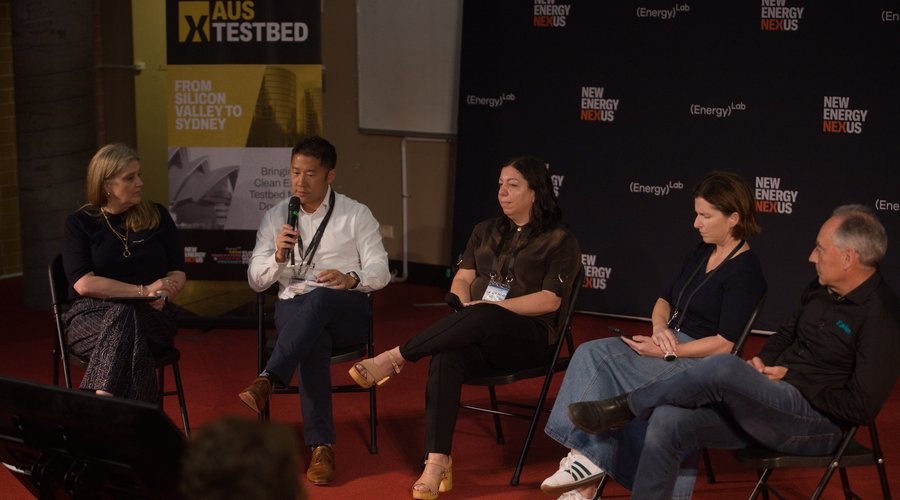
From L - R: Megan Fisher, Andrew Chang, Gabriella Nunes, Kristin Vaughan, and John Wood
Notes
[1] Startups that have participated in New Energy Nexus’ CalTestBed programme have secured US$438 million or AUD$617.9 million in follow-on funding.
Quote sheet
David Hochschild | Chair, California Energy Commission
"California didn't become a global clean energy leader by accident. It happened because we built deliberate public infrastructure around the innovation pipeline — not just policies and targets, but programs that actually got money to entrepreneurs at the stages where private capital wouldn't go. EPIC is one part of that story — ratepayer-funded R&D program that has expedited movement of clean energy technologies toward the market. California is now more than two-thirds powered by clean energy, our battery storage fleet has grown nearly 2,000% in six years, and the companies that went through CalTestBed alone have collectively raised nearly half a billion dollars in follow-on private investment.
When government acts as the first and most patient risk-taker — removing the need for startups to find a private match before they can prove their science — it changes the development trajectory completely. Australia has the science, the universities, and the policy ambition. What AusTestBed offers is the structural mechanism to turn that ambition into a pipeline of commercially validated technologies that investors can actually back. I'm proud to be here for its launch."
Andrew Chang | CEO, New Energy Nexus
"New Energy Nexus has spent 21 years working out what actually moves clean energy entrepreneurs from concept to market — across California, China, Southeast Asia, and now Australia. The answer is rarely more complexity. It's usually simpler: reduce the friction at the moments that matter most.
For hardware startups, the moment that matters most is when you have a working prototype and need to prove it performs. That's where the testing bottleneck sits. That's where CalTestBed intervenes in California, and that's what AusTestBed is designed to do here.
The pilot we're launching today is small by design — three startups, three vouchers, one clear question: does the model translate? We already know the answer from five years of evidence in California, but a pilot is how you build the institutional confidence to fund it properly. We're grateful to Boundless Earth for backing that first step, and we're calling on Australia’s federal government to back the next one."
Megan Fisher | CEO, EnergyLab
"EnergyLab works with Australian clean energy startups every day, and the conversation we have most often is about the gap between what a founder has built and what an investor needs to see before they'll commit. It's not a confidence gap. It's a validation gap. Founders have prototypes. They have the science. What they don't have is the independent, third-party testing data that turns a compelling pitch into a fundable opportunity.
That gap exists because accessing Australia's world-class research infrastructure as an early-stage startup is genuinely difficult. The facilities are there. The expertise is there. But the pathway in — the admin, the cost, the negotiation — is not designed for a team of three people trying to commercialise a new battery chemistry or an industrial heat solution.
AusTestBed removes that barrier entirely. No cost to the startup. No equity. No matched funding requirement. Just access to the facilities they need, at the moment they need them, with the backing of a program that has already proven it works at scale in California. For Australian deep tech founders, this is genuinely new. And it's long overdue."
Kristin Vaughan | Managing Partner, Virescent Ventures
"Companies that come out of programs like CalTestBed are categorically easier to fund. They arrive with data from credible, independent facilities. They've already iterated on the back of that testing. And they have a clearer picture of where their technology performs and where it doesn't - which is exactly the kind of honesty that builds investor confidence. AusTestBed brings that same de-risking infrastructure to Australia to enable far more rapid funding and scaling of urgently needed clean energy deep tech solutions."
Kris Collopy | CEO, Adoxima
“The AusTestBed programme provides Adoxima with access to the funding and facilities required to further develop and strengthen our core IP. Over the next six months, we expect to generate the critical data needed to confidently move upstream into multiple high-value markets.”
Gabriella Nunes | Director, Research & Commercialisation, TRaCE (a collaborative partnership between UNSW and University of Newcastle)
"Our labs were built for research, but research doesn't end at the journal article — it ends when the technology reaches the people who need it. AusTestBed and similar models run under the TraCE program, such as our R&D Vouchers, creates a direct pathway between our facilities and the startups that are closest to making that happen. It brings real-world commercial problems into our labs and creates exactly the kind of applied collaboration that startups are after and universities are increasingly expected to deliver."
return to blog