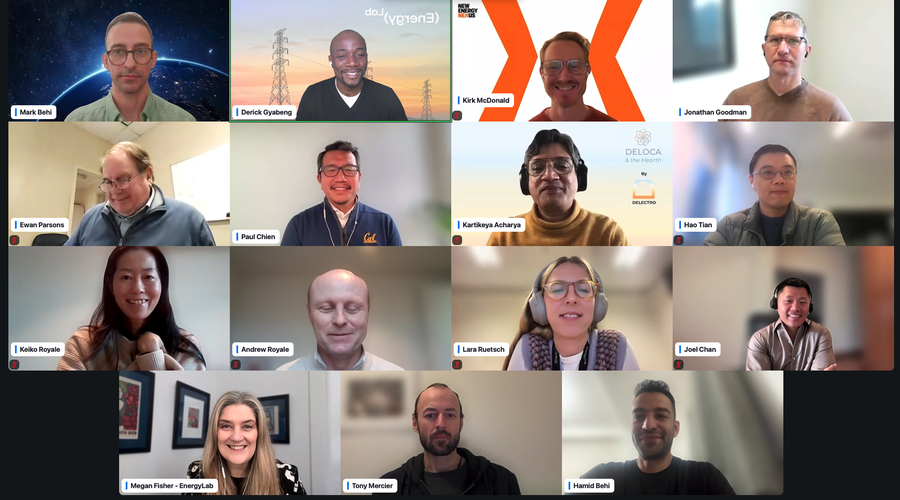
Nine pioneering startups from across the lithium battery value chain presented their vision of Australia’s battery sector to an engaged audience of investors, policymakers, and industry participants at the second Supercharge Australia Incubator Pitch Day.
Watch the full Supercharge Australia Pitch Recording
After eleven weeks of tailored support from EnergyLab and New Energy Nexus, these founders now stand poised to accelerate the country’s battery capabilities - with solutions spanning cleaner lithium refining, safer cell components, Australian-made cells and packs, thermal energy recovery, universal and bidirectional charging infrastructure, consumer participation, and second-life diagnostics.
Here are the participating startups and their lithium battery value chain focus
- Ixium Technologies: Cleaner, cheaper, modular lithium carbonate refining
- IonMatrix Energy: Thermally stable separator membranes for safer cells
- Cosmos Infinity: Next-generation solid-state lithium iron phosphate (LFP) cells engineered for hot climates, made in Australia
- RENOZ Energy: Australian-made battery systems with fleet-scale intelligence
- HASAKI Research and Technology Centre: Thermoelectric waste heat recovery extending electric vehicle (EV) range
- Mercier Designs: The eCube universal exchangeable battery ecosystem
- DELECTRO: DELOCA and the Hearth - a low-carbon participatory lifestyle platform encouraging greater use of midday solar
- V3G: Retrofittable bidirectional vehicle-to-grid (V2G) charging at half the cost
- DYNOVY: Fast, physics-informed grading of used EV batteries for reuse, second life and recycling
The completion of the second Incubator extends Supercharge Australia’s track record: five programs delivered, 50 companies supported, and over $150 million raised or granted by program alumni since participation. The Incubator provides mentorship, expert advice, pilot opportunities, early customer connections, investor engagement, and international exposure, helping these teams build the foundations of Australia’s battery future. We thank our funders - Stephen Pfeiffer, Freddy Sharpe, and the Dusseldorp Forum [CONFIRM each funder is OK to be publicly acknowledged before publishing] - and all of the expert speakers for their generous contributions.
Registrations are now open for the Supercharge Australia Innovation Challenge #4 - an 8-week sprint across the lithium battery value chain with a special focus on the Southeast Asian opportunity, including an overseas trip and introductions. Southeast Asia is on track to be home to 800 million people by 2050, all seeking the energy access and living standards that batteries and clean electrons can deliver. Applications close 6 September.
Building a circular battery value chain
Australia has a generational opportunity to move beyond exporting lithium ore and build a competitive, homegrown battery value chain. The startups in this year’s Incubator show how this is taking shape across every link in the chain, from refining through manufacture, deployment, and second life. Together, they demonstrate what a circular, high-value battery ecosystem could look like:
- Refining battery-grade lithium carbonate with around 70% lower emissions in modular, containerised equipment - thanks to Ixium Technologies
- Making cells safer from the inside with separator membranes stable to 450 degrees Celsius - with IonMatrix Energy
- Manufacturing cells and packs onshore, designed for Australian and Asia-Pacific heat - through Cosmos Infinity and RENOZ Energy, whose packs use Western Australian lithium from Pilbara Minerals and Mineral Resources
- Extending EV range in all climates by converting waste heat into electrical power - with HASAKI Research and Technology Centre
- Deploying batteries in flexible, human-centred ways - through Mercier Designs’ universal eCube, DELECTRO’s DELOCA participation platform, and V3G’s retrofittable bidirectional charging pedestal
- Recovering value at end of first life with DYNOVY’s fast, physics-informed diagnostics for used EV batteries, supporting more confident reuse, second-life and recycling decisions.
With coordinated support, these early-stage innovations can accelerate Australia’s transition from resource supplier to battery technology leader.
Backing Australia’s battery future
Lithium is back. After a prolonged downturn, spodumene prices rose sharply at the start of 2026, with Fastmarkets’ benchmark assessment climbing from around US$1,560-1,590 per tonne at the start of January to US$2,190-2,260 per tonne within a fortnight, and Australian producers now weighing restarts of mothballed operations. The demand story has broadened well beyond EVs: Fastmarkets’ research team has lifted its global energy storage system shipment forecast for 2026 by more than 60%, to 750 gigawatt hours, underpinned by artificial intelligence datacentre construction and the global energy transition.
Each startup in the Incubator cohort is developing a critical piece of the emerging ecosystem, and the kinds of investment opportunities the sector is seeking. While early traction across the cohort was strong - from validated prototypes and filed patents to Clean Energy Council (CEC) certification and deployed megawatt hours - the startups all face the same uphill challenge: securing the capital, facilities, and support to move from validated concepts to scalable commercial impact. The Incubator addresses this gap by de-risking early innovation, reducing barriers to commercialisation, and helping Australia retain its battery intellectual property onshore.
Powering the clean energy transition
Batteries power the clean energy transition, and battery startups have tremendous potential to pave the way, especially when supported early. To further develop this economic opportunity, Australia can adopt proven models like the CalTestBed program in California, which turned US$22 million in early-stage testing access into over US$438 million in follow-on investment by offering non-dilutive, non-matching grants to startups solving big climate problems.
That model has now landed here: in March 2026, New Energy Nexus and EnergyLab launched the AusTestBed pilot with seed funding from Boundless, giving three battery startups - all alumni of the first Supercharge Australia Incubator - A$50,000 vouchers each for independent testing at Australian research facilities. Supercharge Australia is calling on government to fund a full national rollout.
“Building Australian lithium battery capability begins with supporting innovation at its earliest stages - with non-matched and non-dilutive funding to produce prototypes, pilots and real-world testing opportunities,” said Kirk McDonald, Project Manager at Supercharge Australia.
Supercharge Australia is calling for new initiatives to:
- Provide non-dilutive, non-matching seed funding for early-stage lithium battery value chain startups.
- Open access to testing, certification, and demonstration facilities.
- Support pilot customers and fleet procurement to validate new tech.
- Connect investors and government with the pipeline of founders building the sector.
Supercharge Australia has raised all philanthropic funding to date and is raising A$5 million over three years (2027-2030) to continue its program work, welcoming philanthropic anchors alongside industry and government partners. To join the mission as a startup, supporter, mentor, or industry partner, get in touch.
The Second Supercharge Australia Incubator Cohort
Founder(s) Paul Chien
Description Next-generation solid-state LFP battery cells engineered for hot climates - prismatic 65 Ah, 50 Ah, and 12 Ah formats for energy storage, telecommunications, uninterruptible power supply (UPS), EV, drone, and electric vertical take-off and landing (eVTOL) applications, manufactured in Australia on an artificial intelligence and robotics-driven pilot line requiring just one operator.
Early Traction Validated over 30% improvement in cycle life and materially safer operation in high-temperature environments; in discussions with equipment partners for a fully automated line.
Short-Term Deliverables A 10 megawatt hour pilot line supported by defence qualification, then a jump to a 1 gigawatt hour grid-scale line once the cell design is frozen and an anchor customer is signed.
Key Ask Raising A$16 million to build the pilot facility and grow the team.
Link to pitch recording https://www.youtube.com/watch?v=smbV5LKOaeE&t=532
Founder(s) Kartikeya Acharya
Description DELOCA, a low-carbon participatory lifestyle platform, paired with the Hearth, a portable battery-powered personal appliance designed and made in Sydney. Charge during low-carbon, solar-rich periods and unlock fresh local produce, products, and experiences.
Early Traction Fresh provisional patent on the DELOCA software; collaboration with global leaders in portable battery technology.
Short-Term Deliverables A commercial pilot in the City of Sydney with 20 Hearths.
Key Ask Pilot partners - distribution network service providers (DNSPs) and utility companies - and open to investor conversations.
Link to pitch recording https://www.youtube.com/watch?v=smbV5LKOaeE&t=838
Founder(s) Ben Behi, Hamid Sistani, Mark Behi
Description Dynovy is building a hardware-enabled software platform for fast grading of used EV batteries, designed for high-volume operators where full-cycle testing is too slow or costly for industrial throughput. It captures battery response signals in short diagnostic windows and applies battery-physics models and low-data algorithms across cell, module and pack architectures to produce state-of-health, risk and routing outputs without relying on BMS history. The founding team combines senior battery engineering and safety experience from Dyson, scalable software infrastructure experience from Amazon, and extensive deep-tech commercialisation and venture-building experience.
Early Traction Controlled testing has demonstrated diagnostic windows up to ten times shorter than full-cycle reference tests, with state-of-health deviation under 5%. Dynovy has filed two patents, developed pack-level models and deployment architecture, and maintains an ongoing technical relationship with a major recycling operator. The technology is at TRL 3-4 based on cell and module validation.
Short-Term Deliverables Industrial pack-level validation over the next three to six months, benchmarked against current operator methods and building toward a first paid pilot.
Key Ask Validation partners in recycling and repurposing, including access to used packs, modules and benchmark data. Dynovy is also open to early pre-seed investor conversations.
Link to pitch recording https://www.youtube.com/watch?v=smbV5LKOaeE&t=1168
Founder(s) Jonathan Goodman, Richard Ellison
Description Taking the heat out of lithium refining. A crystallisation process and equipment that cuts the emissions of lithium carbonate purification by around 70% while reducing equipment size, capital, and operating costs - modular, scalable, and containerisable.
Early Traction Demonstrated crystallisation control in an improved reactor; progressing toward battery-grade product. Targeting battery recyclers and new lithium extraction technology companies handling 10 to a few thousand tonnes per year.
Short-Term Deliverables Re-engineering the reactor for continuous operation, delivering battery-grade lithium carbonate within 18 months.
Key Ask Raising a $2 million pre-seed round; connections to companies needing cleaner, cheaper lithium refining.
Link to pitch recording https://www.youtube.com/watch?v=smbV5LKOaeE&t=1495
Founder(s) Tony Mercier
Description The eCube exchangeable battery ecosystem: modular, divisible, stackable batteries capable of powering vehicles, home systems, and devices - plug and play, transferring power between each other, and simple enough that connection requires no qualified electrician.
Early Traction Two University of Technology Sydney (UTS) engineering student teams researched the concept in 2024; a University of New South Wales (UNSW) report analysis indicated feasibility, recommendations, and potential markets. Patent pending; in talks with a battery expert from Taiwan.
Short-Term Deliverables Research and development and prototyping, followed closely by manufacturing.
Key Ask Seeking $1.2 million.
Link to pitch recording https://www.youtube.com/watch?v=smbV5LKOaeE&t=1835
IonMatrix Energy
Founder(s) Hao Tian
Description Thermally stable, aramid-based separator membranes that keep their shape under extreme heat, increasing safety margins from inside the cell - stable to 450 degrees Celsius where standard polypropylene and polyethylene separators shrink and melt around 150 degrees Celsius.
Early Traction Validated over 400 cycles in LFP coin cells and over 900 cycles in pouch cells, at under 10 micron membrane thickness; non-disclosure agreement (NDA) discussions underway with manufacturing and battery testing partners.
Short-Term Deliverables Pilot membrane rolls and testing samples for partners within six to nine months; first paid co-development agreement within 12 months.
Key Ask $1 million in pilot funding plus strategic manufacturing and testing partners.
Link to pitch recording https://www.youtube.com/watch?v=smbV5LKOaeE&t=2160
Founder(s) Simon Chan; presented by Joel Chan, Operations Manager
Description Perth-based manufacturer of lithium-ion battery packs for stationary storage from 5 kilowatt hours to 2 megawatt hours, using cells containing Western Australian lithium from Pilbara Minerals and Mineral Resources, with cell-level remote monitoring and a fleet management platform developed with EnergyLab alumnus Dominic Spooner of Vaulta.
Early Traction Clean Energy Council (CEC) certification achieved in a record four months; 1.5 megawatt hours deployed across three states and 35 sites.
Short-Term Deliverables Proving fleet-scale deployment with operators of remote, operation-critical infrastructure such as standalone power systems (SPS).
Key Ask Three to five pilot operators electrifying remote infrastructure across mining, agriculture, and regional communities. Meet the team at All-Energy Australia in October at the EnergyLab Clean Energy Startup Zone.
Link to pitch recording https://www.youtube.com/watch?v=smbV5LKOaeE&t=2439
HASAKI Research and Technology Centre
Founder(s) Andrew Royale, Keiko Araki
Description Specially designed thermoelectric generators that recover thermal waste heat from EVs and convert it into electrical power, creating a secondary system for heating and air conditioning so 100% of the battery drives the vehicle - a solution to the 20% range loss when the heater switches on.
Early Traction Technical capability proven with proof of concept complete and world-leading industry partners supporting development; the automotive thermoelectric generator market is expected to grow to $600 million by 2031, with the technology adaptable to trains, trams, buses, boats, appliances, and datacentres.
Short-Term Deliverables Prototype development, technology demonstration, and customer engagement.
Key Ask $1.6 million over a three-year period.
Link to pitch recording https://www.youtube.com/watch?v=smbV5LKOaeE&t=2760
Founder(s) Ewan Parsons, supported by a team including Mark Purcell AM, Rear Admiral (Rtd)
Description A bidirectional pedestal delivering vehicle-to-grid capability at half the cost, by converting the vehicle-to-load alternating current output from the car into a direct current input for the household’s existing solar inverter - a globally unique retrofit that means EV owners with solar keep their current inverter.
Early Traction A full V2X product range developed and ready for operation in partnership with WattsUp Market - the V2X Isolator, V2H HOEM, V2X UNO, V2X BiDi, and the flagship V2X Pedestal, which changes colour according to grid status. Over 80% of customers report wanting vehicle-to-grid capability.
Short-Term Deliverables Commercialisation of the bidirectional pedestal and progress toward advanced manufacturing.
Key Ask Up to $500,000 from an active investor (up to 50% of the company, currently valued at $1.2 million; 30% for a passive investor), plus partners to support a 50:50 contribution for advanced manufacturing funding.
Link to pitch recording https://www.youtube.com/watch?v=smbV5LKOaeE&t=3019
Read about the inaugural Supercharge Australia Incubator cohort: These early-stage startups are shaping Australia’s battery future.
return to blog