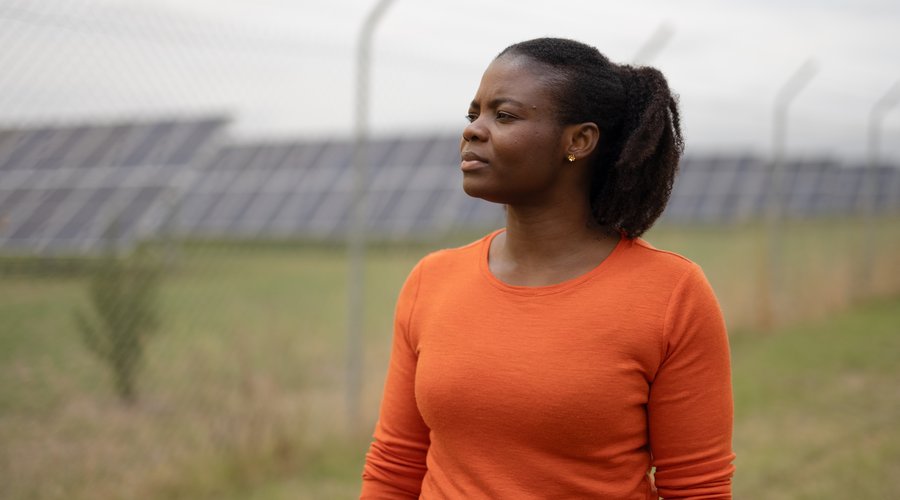
Driven by a lifelong dedication to impact, EnergyLab alumni Kate Osaze is building Reswitch to ensure communities hosting clean energy infrastructure share in its benefits. Read on to learn more about Kate’s journey from engineer to founder.
A Start in Power Systems
A desire to create change has guided Kate Osaze’s career from the very beginning, even before she became a founder. Her motivation for entering the energy sector was rooted in addressing one of society’s most fundamental challenges: access to affordable, reliable energy.
Kate began her career working within Australia’s electricity sector, where she spent more than a decade helping deliver large-scale wind and solar projects. During that time, she watched the renewable energy sector scale rapidly. But she also began noticing a challenge that was becoming increasingly difficult to ignore. As the sector grew, community engagement became increasingly important to project success, with delays - and in some cases project abandonment - occurring when engagement happened too late, particularly as projects moved closer to regional communities.
“I began to realise that the success of the energy transition depends not just on infrastructure, but on the communities hosting it,” she says.
“At first, I approached renewable energy projects mainly from an engineering perspective. Over time, I realised that successful projects depend on building genuine partnerships with the communities hosting them.”
Discovering the Startup Path Through EnergyLab
Kate’s transition into entrepreneurship began through EnergyLab. In 2019, she joined the inaugural cohort of the Women in Climate and Energy Fellowship.
“I did not come in with a fully formed idea,” she says. “I joined because I wanted to learn how to approach problems differently and understand how technology could help solve them. I entered the program with curiosity.”
During the WICEF program, Kate began exploring how technology and innovation could help address energy challenges. Her original concept focused on improving energy affordability through access to solar energy in developing countries. Through conversations with mentors, customers and industry stakeholders, she realised the model she was exploring wasn’t the right solution. Instead of forcing the original idea, she stepped back, reassessed and waited for a problem she really wanted to solve.
The program also introduced her to customer discovery: the practice of researching and interviewing stakeholders to deeply understand the problem before building a solution.
“It gave me a framework to look at problems and validate them properly,” she explains. “That process was incredibly valuable when the idea for Reswitch eventually emerged.”
Over time, her work in renewable energy development began pointing her toward a different opportunity.
A Hidden Challenge in the Energy Transition
As countries accelerate the shift to renewable energy, we need more space for large scale infrastructure. Wind turbines, solar farms and transmission lines are essential to decarbonising the grid, but they are also being built in the heart of regional communities.
For Kate, a significant ‘aha’ moment came during a conversation with farmers in regional Australia.
“I found myself in a room full of farmers and I introduced myself as someone working on renewable energy projects,” she recalls. “What I saw wasn’t hostility, it was fear and uncertainty about what the energy transition meant for their communities.”
The stories she heard were powerful. One farmer explained that although developers had offered significant financial incentives to host wind turbines, they declined because they feared it would divide their community. Another described the anxiety caused by transmission lines being built across private land.
“These are people whose sense of identity is tied to the land and their community,” Kate says. “It’s not just about money. It’s about whether the transition is happening with them or to them.”
Hearing directly from community members revealed a side of the energy transition Kate previously hadn’t fully appreciated. She realised something fundamental: the energy transition cannot succeed without genuine engagement and partnerships with regional communities.
“The minimum benefit we could provide people who host energy infrastructure is to address energy affordability.”
The Idea Behind Reswitch
A few years after her first idea in the WICEF program, Kate began exploring a new concept: how to ensure communities hosting renewable energy infrastructure receive tangible benefits from the projects built around them.
Her experience working in the industry had shown her that developers wanted to do more for communities, yet they often struggled to deliver benefits that meaningfully address household energy costs in a scalable way and frictionless for community members. Kate saw an opportunity for technology to help bridge that gap.
The idea that emerged became Reswitch, a digital platform that enables renewable energy developers to map project neighbours and deliver tangible community benefits, including electricity bill reductions, directly to households and businesses near energy infrastructure.
Using Reswitch, developers can identify impacted households within defined geographic boundaries, allocate benefits transparently, and deliver electricity bill rebates straight to residents’ existing electricity accounts, without requiring them to switch electricity providers. Residents see those benefits reflected directly on their electricity bills.
“The minimum benefit we could provide people who host energy infrastructure is to address energy affordability,” she explains. “Reswitch makes it simple for developers to share the economic benefits of renewable energy with the communities around them.”
“The goal is to create a tangible connection between local generation and benefits that communities can actually see and feel” Kate says.
By doing this, Reswitch helps strengthen community engagement and build trust between developers and communities, an essential ingredient for accelerating renewable energy deployment.
“The goal is to create a tangible connection between local generation and benefits that communities can actually see and feel”

The Road to Launch
Unlike instant startup success stories, Reswitch did not emerge overnight. Kate spent significant time validating the problem before committing full-time.
Drawing on customer discovery frameworks from her WICEF experience, Kate spoke with developers, community engagement specialists and community members to better understand the challenge.
“I wanted to be confident this was a problem worth dedicating years of work to - one that could strengthen partnerships with host communities” she says.
Over time, the signal became increasingly clear. Industry leaders were discussing community engagement risks and social licence challenges across renewable energy projects, year after year, yet few practical and scalable solutions existed.
“I remember thinking, we can keep talking about these challenges at conferences, or we can start building solutions.”
In 2024, Kate left her full-time role to focus entirely on Reswitch. The decision to leave a stable career and start a company was not easy, but after years working in the industry and validating the problem through conversations with developers and communities, Kate felt the time was right.
“I knew I needed to commit to exploring the idea properly and test whether this was a problem worth solving at scale,” she says.”
Current Status
Today, Reswitch is a software platform with two key components:
- A developer portal, where project teams can map and identify community members near their projects and allocate community benefits.
• A community web platform, where residents can access and track their electricity bill rebates.
Reswitch is now being used across multiple energy infrastructure projects in Australia, including wind, solar, battery, and transmission - helping local communities receive cheaper power as a direct benefit from nearby projects, while enabling developers to deliver tangible and transparent community benefits at scale.
“We now have several communities on the platform. Seeing community members experience the platform and have energy affordability addressed through benefits from local energy projects is incredibly exciting,” Kate says.
For Kate, the mission behind Reswitch connects directly back to the impact that first drew her into the energy sector.
The transition to clean energy is one of the most important infrastructure transformations of our time. For Kate, success means that the transition works for everyone. This means communities are not just hosts for renewable infrastructure, but participants in the benefits it creates. Reswitch is building a future that works for both the planet and people.
Want to follow Kate the ReSwitch journey? Follow Kate on LinkedIn and visit the ReSwitch website.
Interested in joining one of EnergyLab’s programs? Head over to our programs page for more information.
return to blog